A Play Doh Cake and the Practice of Celebrating You
This week, I was with a client who announced they wanted to make a cake. With play doh, of course. So we started rolling and patting and stacking little layers like it was the most important bakery in town.
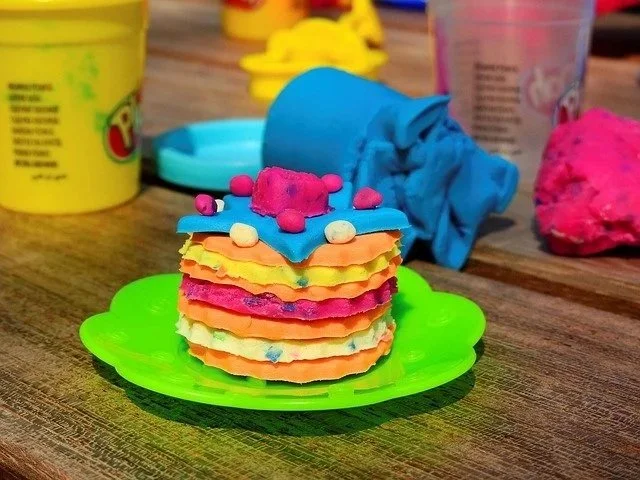
I asked, “Who are we celebrating?”
They paused. Looked down at the cake. Then said they weren’t sure.
So I asked a different question. “What if we celebrate YOU?”
And without missing a beat they said, “I don’t like to celebrate myself.”
Whew. That landed.
Because a lot of us learned how to show up for other people’s birthdays, graduations, promotions, and milestones. We know how to clap for someone else. We know how to send the text, buy the gift, bring the snack tray, and hype them up.
But when it is our turn, even in small ways, we freeze. We minimize. We get uncomfortable. We tell ourselves it is not a big deal. We tell ourselves we have not earned it. We tell ourselves we should wait until we are better, calmer, more productive, more healed, more consistent.
And honestly, some days it is not even shame. It is survival. When you have lived in a nervous system that is always scanning for what might go wrong, celebration can feel like a setup. Like you are tempting fate. Like if you relax for one second, something will fall apart.
But here is the thing. Celebrating yourself is not arrogance. It is acknowledgment. It is a way of telling your brain and body, “I am here. I matter. I did something hard. I am allowed to notice that.”
It is also a nervous system skill.
Celebration is one of the ways we teach our bodies that safety is not only the absence of danger. Safety is also the presence of goodness. Safety is being able to name a win without waiting for the other shoe to drop. Safety is letting pride and gratitude take up space, even if they only stay for a minute.
And the days you do not feel like celebrating? Those are often the most important days to practice it.
Because if you only celebrate when everything is perfect, you are basically telling yourself that you only deserve kindness when you are performing well. That is not self care. That is a contract.
Some victories are loud. Big milestones. Big transitions. Big breakthroughs.
But most victories are quiet.
Getting out of bed when you wanted to disappear.
Taking your meds.
Answering the email you have been avoiding.
Cooking something that counts as a meal.
Not snapping, even though you were overstimulated.
Setting one boundary.
Crying and not apologizing for it.
Going to therapy.
Leaving the relationship.
Staying in the relationship and doing the work.
Saying, “That hurt,” instead of swallowing it.
Trying again after you messed up.
Those are victories. They count. They are evidence that you are moving, even if you are moving slowly. They are proof that you are alive and trying.
Celebration is not about pretending life is easy. It is about refusing to overlook your effort.
So let’s make this practical.
Action plan: Small ways to celebrate yourself (even on the days you do not feel like it)
Name it out loud
Say, “I’m proud of me for ___.” Even if it feels cheesy. Even if you whisper it. Your brain learns through repetition.Take a tiny victory photo
Snap a picture of something that represents the win. Your walked shoes. Your finished laundry basket. Your therapy notes. Your play doh cake. Keep a small album called Proof.Do a two minute reward
Two minutes of something that feels good. Step outside. Stretch. Put on one song. Make a fancy drink in a regular cup. You are teaching your body that effort can be met with care.Make a “small win” list
Not a to do list. A done list. Write down three things you did today that required energy. This is especially powerful for trauma days and ADHD days.Give yourself a gold star like a child
Stickers are not just for kids. Neither is the joy of seeing evidence that you showed up. Put a sticker on your planner, your water bottle, your mirror, wherever you will see it.Celebrate with a person who is safe
Send a text to someone who will not minimize you: “I did a hard thing today. Can you hype me up for a second?” Let connection be part of the celebration.Create a simple ritual
Light a candle when you finish something. Wash your face slowly after a hard day. Make your bed like it is a reset button. Small rituals tell your nervous system, “We made it through.”Practice receiving
If someone compliments you, try this: “Thank you. I’m letting that land.” No explaining. No deflecting. Just receiving.
If you need permission, here it is.
You do not have to wait until you feel fully confident to celebrate yourself. You celebrate as a way to build confidence. You celebrate as a way to build safety. You celebrate as a way to practice being on your own side.
So yes, make the play doh cake. And if you are not sure who it is for, let it be for you.
Because you are worth celebrating. Especially on the days you think you are not